


He asked for a human. They said use AI.
In a business group I’m in on social media, an experienced professional was looking for recommendations to build a website. He had a style and brand in mind and specifically wanted to work with humans – just not a large agency. The responses were mostly use this AI tool, and you can do it for cheap.
Multiple times, this person kept responding I want a human who has experience. Many of the comments said – use AI and it will be “good enough.”
The irony wasn’t lost on me: a professional asking for human craft was being told, by other professionals, that a machine would suffice.
That phrase hasn’t left me.
I am concerned about AI from many angles – environmental resources on how much energy they are using, the loss of critical thinking skills, and the phrases that sound alike (now sometimes I find I’m tired of the same phrases and they aren’t from AI, but it might sound like it is).
And then there’s the loss of jobs – debated all the time, and a concern that impacts our own profession.
Let’s stay on the environmental piece for a moment, because the numbers are staggering.
A single AI-focused data center can consume as much electricity as 100,000 households and up to 5 million gallons of water a day for cooling. The International Energy Agency projects global data center electricity demand will more than double, with AI workloads driving most of the growth.
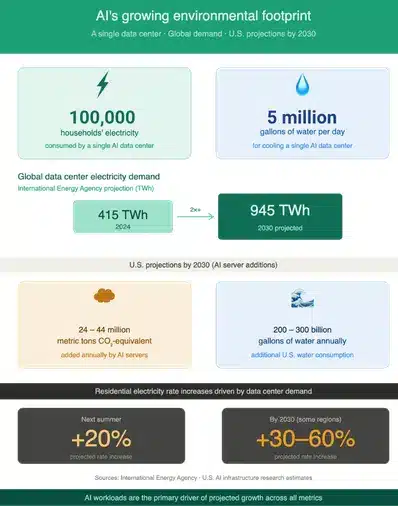
In the U.S. alone, AI servers are expected to add 24 to 44 million metric tons of CO2-equivalent emissions and 200 to 300 billion gallons of annual water consumption by 2030. In parts of the country, residential electric rates are already projected to climb 20% next summer and 30-60% by 2030 because of data center demand.
This is why Erin Brockovich – yes, that Erin Brockovich – just launched a new website, Brockovich AI Data Center Reporting, mapping AI data centers across the U.S. and inviting residents to report what’s happening in their communities.
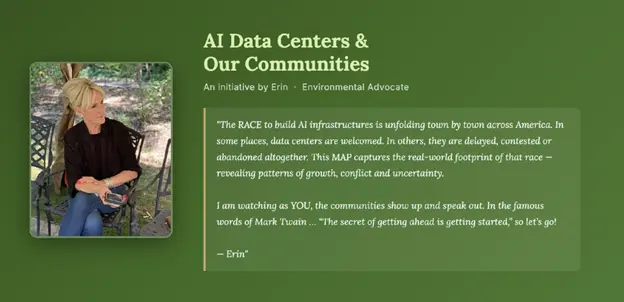
She’s not exactly anti-AI. She’s pushing for transparency, public engagement, and honest disclosure of resource impacts. Gallup recently reported that 70% of Americans oppose the construction of data centers in their communities, with 48% strongly opposed.
When we shrug and say “good enough,” we’re also shrugging at the water bill, the power grid, and the neighbor who didn’t get a vote.
And I’m not alone in feeling this way.
A 2025 Pew Research study found that 53% of Americans believe AI will worsen people’s ability to think creatively, compared to just 16% who believe it will improve it. Among adults under 30 – the generation supposedly most fluent with these tools – 61% say the same.
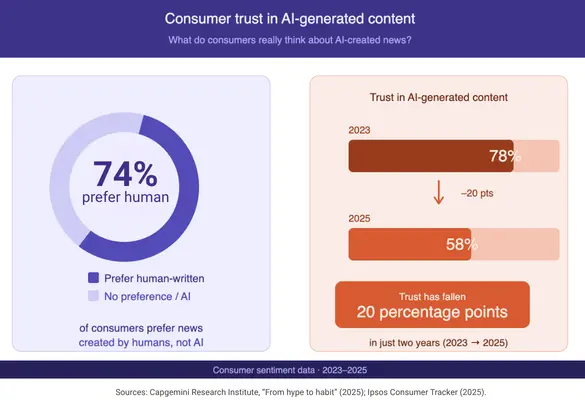
Ipsos has tracked this for years: 74% of consumers prefer their online news come from humans, and three-quarters prefer human-created photojournalism.
A YouGov study of nearly 10,000 consumers across seven markets found that 32% would trust a brand less if they knew its content was AI-generated, versus only 15% who would trust it more. “From hype to habit” study of 10,000 consumers across 13 countries found that global trust in AI-generated content has fallen from 78% in 2023 to 58% in 2025 – a decline across every age group, including Gen Z.
The data is telling us something we already feel in our bones: people can sense the difference, and they care.
Many people say AI will make people more efficient, it will reduce mundane tasks, and people can spend their time on the strategic things. And sometimes that’s true.
But “efficient” and “good enough” aren’t the same thing, and in privacy, the difference between the two can be the difference between a compliant program and a regulatory headline.
A generic AI-generated privacy notice may technically check a box, but does it actually reflect how your company collects, uses, and shares data? Probably not.
Let’s take my initial example – the very people who say use AI are business owners themselves. I kept wondering – would they be OK if someone said use AI to do the very service they offer? To replace them and say, “It’s good enough.”
Do we really want to resort to good enough?
People crave experiences. Think about the last time you went to a movie, a live concert, or the theatre. If you loved it, you remember it, you share the experience with people, and it stays with you.
If it’s just good enough – how do you feel? Probably annoyed that you wasted your time and money on that.
What about going on vacation – do you really want “good enough”?
Or the meal at a restaurant you saved up for – is “the chicken was fine” the review you were hoping to write?
What about your morning coffee – do you settle for a gas station drip when there’s a roaster down the street that actually cares about the bean?
We don’t settle on the things that matter to us. We seek out the people and places that do the work well.
So why are we suddenly so willing to settle when it comes to our work?
When did “good enough” become a goal instead of a warning sign?
If we wouldn’t accept a “good enough” surgeon, a “good enough” wedding photographer, or a “good enough” babysitter for our kids, why are we so quick to accept “good enough” for the things our customers, our teams, and our regulators see?
What does it say about how we value our own professions when we offload them to a tool and call the output acceptable?
And here’s the one that really sits with me: if everyone uses the same AI to produce the same “good enough” output, what exactly is anyone paying for?
Ever say there’s nothing to watch after scrolling Netflix, Hulu, Disney+, Amazon Prime, and YouTube TV? Thousands of shows and yet it’s often just “ok” – I don’t really want to spend my time with “good enough.”
A recent Delta flight with thousands of hours of options to pick from – none were appealing, so I listened to Classical music, where my brain and body enjoyed the calm (and science shows it was good for me – that’s a bonus though).
If we’re struggling with content now, how is an AI show that will regurgitate the same info over and over again enough for us?
Where’s the creative spirit that embodies humanity?
I was talking with a recent college grad with a marketing major, and she’s itching for more creativity in her job, so she’s creating visual reports instead of traditional Excel reports.
Why? Because creativity is what makes us human.
If everything is AI, where’s the uniqueness? The differentiation? The invention and design that we can really appreciate?
I think of the business executives I work with who pour their personality into their brand voice, the engineers who sketch out a privacy-by-design architecture on a whiteboard before a single line of code is written, and the lawyers who negotiate a data processing agreement word by word because the details actually matter.
None of that is “good enough” work – it’s their work.
If we tie this to our own profession, do you really want to give a presentation to the leadership that’s good enough? Likely not.
You want it to convey what matters about your privacy program – to think like the leader and fill in the gaps.
Privacy is a field where “good enough” carries real consequences.
A “good enough” data inventory misses the data being shared with an unvetted third party that’s free to use it for their own purposes. A “good-enough” vendor review skips the sub-processor list.
A “good enough” incident response plan looks fine on paper until the day you actually need it. A “good enough” cookie banner might not actually be doing what you think it is.
The work of building a privacy program – understanding your data, your people, your risks, your culture – is deeply human work. It requires judgment, context, and the kind of curiosity that asks “but why are we collecting this in the first place?”
An AI tool can help you draft, summarize, and organize. It cannot care about your customers for you.
And consider this through a privacy lens: a NIM study found that only 28% of consumers understand how their personal data is used by AI to personalize the content they see, and only 20% trust AI itself.
Your customers are already skeptical. They are already wondering what happened to their data the moment it touched a model.
If your privacy notice, your consent flow, your breach response – any of it – feels like it was churned out by a machine that doesn’t know your business, you are widening a trust gap that was already there.
“Good enough” privacy work doesn’t just risk not complying with a privacy law. It risks losing customer trust.
The work that matters deserves more than “good enough.” It deserves a human who cares, and that’s still us.
Jodi
💡 When you’re ready, here’s how we can help:
⚙ Privacy Advisory & Implementation: We help companies navigate privacy requirements with confidence. Our advisory support covers strategy, operations, and real-world implementation.
⚙ Fractional Privacy Services: We provide fractional privacy leadership tailored to your needs and pace. From program development to day-to-day support, we help you build and sustain a strong privacy program.