


Summer camp season is here and that means a pile of forms to complete. As a camper, my youngest was not happy that I had to fill out forms with her health information.
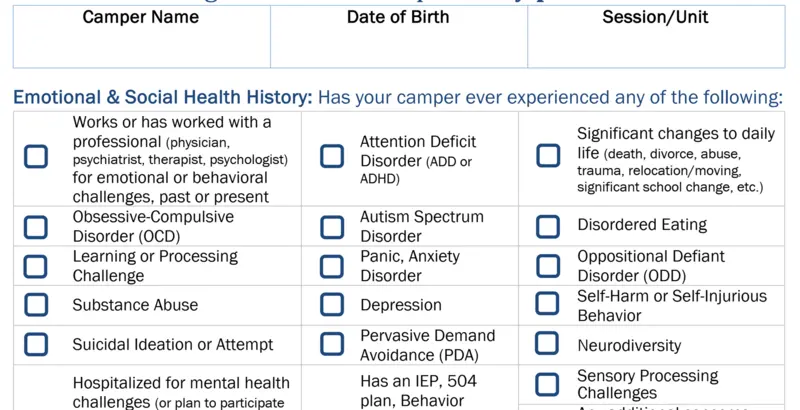
She kept saying this is private, why do they need to know all of this? Once I explained that the camp is responsible for taking care of her and needs to know about her health to do that well, she still wasn’t thrilled, but she got it.
My oldest is heading into camp as a counselor this summer, and guess what – she also had to submit health information. My husband and I both raised an eyebrow. Why does a counselor need to fill out what looks like a camper health form?
I did what I always do and went to Google. Turns out, once a job offer is made, employers can ask for health-related information if it’s relevant to the role. If her job is supervising kids outside all day, the camp wants to know she’s physically able to do that. That makes way more sense now.
Both situations are a good reminder of something I see come up over and over again in my work: people are much more willing to share information when they understand why it’s being asked for. My daughter didn’t love it, but once she had the context, she accepted it. That’s why context matters.
The privacy notice problem
Privacy notices are legally required, and I write them for clients. They serve an important purpose. But let’s be honest – nobody is reading a privacy notice before they fill out a camp health form. Or really before they do most things online.
What actually works is what I call a just-in-time explanation. A short line of text above a form field. A little “i” icon that expands when you tap it. A note at the top of an email before you even download the form. Something that meets people right where they are and answers the question before they even think to ask it.
That small moment of clarity makes a real difference.
Less is More
I was working with a company launching a loyalty program. They wanted to collect date of birth as part of the sign-up, which is totally normal for a loyalty program. Birthday perks are often expected, and people get why you’d ask.
But here’s the question I pushed them on: do you need the full birthdate, including the year, or just the month and day?
If the whole point is to send a birthday discount, you only need the month and day (and maybe just the month if you extend the discount beyond the day anyway). The year adds a layer of sensitivity that isn’t necessary for the stated purpose.
After visiting a coffee shop that uses Square payments, they almost immediately ask for my birthday. Here’s the most recent email I got and what the landing page looks like – at least this one is asking just month and date (it doesn’t need the year).

It’s a small distinction, but it’s exactly the kind of thing that shows whether a company has really thought through what it’s asking for. And when you pair that form field with a simple line like “We use your birthday to send you a special treat each year,” the whole thing feels reasonable. People get it. They share it happily if they actually want to visit your store again (unlike me for the random coffee shop I visited while traveling).
Context changes everything.
When there’s no explanation at all
Here’s one that has genuinely puzzled me for a long time. A popular document signing tool I use regularly asks for my precise location every time I sign something. Not my general area. My precise location.
I understand why a signing platform logs the date, time, and device. That all makes sense for legal purposes. But why does it need precise location to sign a document?

And that’s exactly what creates distrust. Not necessarily because something bad is happening, but because when there’s no explanation, people assume the worst. Our brains fill in the blank, and we usually don’t fill it in charitably.
Online quizzes are another good example. You know the ones – “What kind of leader are you?” or “What’s your work personality style?”
They’re fun and people click on them all the time. But you’re sharing a lot. Your habits, your tendencies, how you think, how you work.
The problem is most quizzes never tell you what happens to those answers. And there’s a real difference between “your answers are used to generate your result and nothing else” and “we also use your responses to send you content and offers.”
Both can be completely fine. But people should know which one is true before they start answering, not have to hunt for it in a terms page. Just say what’s actually happening with the data in real time near where what you’re asking for.
More context, more trust, more sharing
This is the thing I want every company to take away from this is transparency is not just about legal compliance.
It’s about what happens to the relationship when people feel informed versus when they don’t.
When someone understands why you’re asking for something, they’re more likely to give it to you accurately and willingly. When they don’t understand, they hesitate, they guess, they give you bad data, or they abandon the form entirely. None of that helps your business.
My daughter is a perfect example. Same forms, same information, same camp. The only thing that changed was that she understood why. And that changed her whole response to it.
Precise location on a signing form feels invasive. Precise location on a maps app feels obvious.

A simple thing you can do this week
Pull up one form, one sign-up flow, or one data collection point in your business. Read it as if you’re a customer seeing it for the very first time. Does it make sense? Is it obvious why each field is there? Would you fill it out without hesitation?
If the answer to any of those is “not really,” you’ve found your starting point.
You might just need one clear sentence explaining why you’re asking. That’s it. That’s the whole thing.
Privacy done well isn’t complicated. It’s just honest.
What user flow have you noticed that doesn’t make sense to you? Drop me a line and let me know!
Jodi
💡 When you’re ready, here’s how we can help:
⚙ Privacy Advisory & Implementation: We help companies navigate privacy requirements with confidence. Our advisory support covers strategy, operations, and real-world implementation.
⚙ Fractional Privacy Services: We provide fractional privacy leadership tailored to your needs and pace. From program development to day-to-day support, we help you build and sustain a strong privacy program.