


What were your childhood car discussions like? I grew up in a family of car fanatics who swapped cars constantly, some new, some just new to them.
Our car rides meant the license plate game and “hey, check out that new grille or those tail lights.” That hasn’t changed. My mom commented on a Volvo’s tail lights the other day; I pointed out a Lexus grille. Totally normal for us.
Nowadays, though, I have to wonder – is my phone recording that conversation? And if I hop online to look up a car I spotted on the road, am I suddenly “in market”?
With today’s ad-tech capturing browsing data and reverse-engineering who I am, some dealership or manufacturer might decide I am. This isn’t unique to cars. It’s just ad-tech. But today we’re sticking with cars.
I still love new cars, and I still have my favorite features. But when my kids came along, and I decided I would no longer bend like a pretzel to wedge a car seat into the middle of my nice, fast, sporty sedan, my get-a-new-car-often era was over.
I’m not in market. Fun fact: we are happily a two-Kia-Telluride family.
Why is this relevant?
All of a sudden, I started receiving messages from the last dealership I bought a car from YEARS AGO, indicating that I’m in market for a car and that they’re so glad to respond to my inquiry. I’ve received emails, texts, and phone messages telling me to reach out urgently about a trade-in value, what a great deal they have, and from multiple salespeople.
I had an entirely different newsletter planned for today. That got punted after I received an email from yet another salesperson, and as soon as I opened the email, my phone rang from that salesperson.
My immediate thought: they think they are so cool with their tracking technology.
My privacy brain is saying this is where personalization and targeting is “creepy” – and yes, it’s an official industry term.
Exhibit A: this morning’s email.
- This ridiculous fake sense of urgency subject line. Ugh, sleazy car salesperson vibes. It reminds me of the time Justin (my husband) and I RAN from a dealership to get away from a salesperson (absolutely true story).
- They don’t want to bother me with endless emails and voice messages – then why are they doing just that?
- My favorite – the opt-in line – they are already texting me… What’s the point of this??
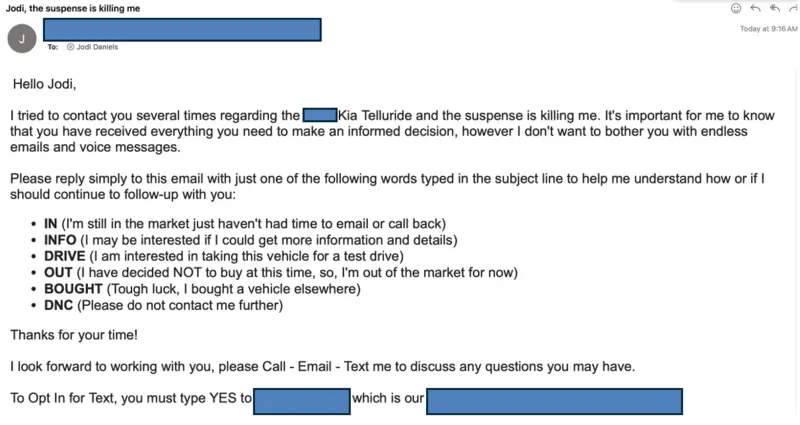
Why the phone call? Because an open-tracking pixel likely pinged her the second I opened the email, and she dialed. The email hit my inbox at 9:16 am. My phone rang at 9:20. Four minutes.
Nobody in that workflow paused to ask whether a human being actually wants to be cold-emailed and cold-called in the same four minutes.
Where’s what’s best for the customer in their marketing strategy?
This is marketing gone wrong. So why did it happen? After years at Cox Automotive and with clients across the automotive space, I know how this works. I bought my car from this dealership years ago, so they have data on its age and industry estimates for how often people trade in. They’re trying to entice me to upgrade.
Fine. The problem is the execution. Their messaging says I’ve inquired. I haven’t. They’re bombarding me with sequences from multiple people in every format at once. And the real lapse in judgment: calling the moment I opened the email.
For the record, I’m not opposed to email tracking. I’m not opposed to marketing or even direct calling. It’s the connection of these activities, the volume of which they were done, and that all the marketing is predicated on bad data. I have made no inquiry, and I’m not in market for a car.
How do customers react?
There are a lot of people like me. They don’t like pushy marketing. They don’t want messages in every format, at hours they don’t expect, based on old data. (Anyone else gotten a warranty letter for a car they sold five years ago? It’s because your data is sold and sitting with some random third party.)
As for this dealership? I’m angry. If I wanted a fourth Kia (I started with a Sorento which is a great car!), I might not go back. Trust was broken over pushy marketing, and the irony is that their aggressive tactics likely cost them a future sale.
The US auto industry is a $1.5 trillion business – fierce, competitive, and data hungry. My data is shared and sold all day long. Back in the late 2000s, my job at AutoTrader was to build a targeted ad network to, as I nicely put it, “stalk” people for cars. I got calls all day trying to sell me “automotive shopper” data, and calls asking to buy ours. The data is valuable.
My privacy rule: just because you can doesn’t mean you should.
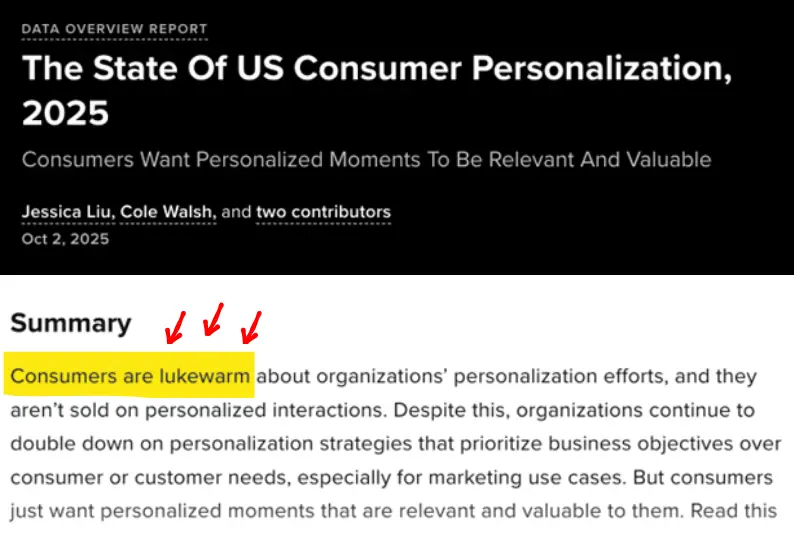
Companies are data-hungry to personalize. Consumers aren’t sold on it – see Forrester State of US Consumer Personalization 2026 report below.
What could this dealership have done?
👒 Wearing a privacy hat, the marketing teams should have thought about:
- Do I have accurate data? (uh … no, you don’t – I never inquired about a car)
- How old is the data we’re basing this on, and do we have a rule for when it’s too stale to use?
- Are our campaigns and sequences too frequent?
- Should the messaging come from multiple salespeople?
- Who has reviewed the messaging to make sure it’s relevant?
- Is the customer OK to send multiple messages per day?
- Do the emails look spammy (yes, the email-from sender in many of them does), where a user might be discouraged from opting out? Good for the dealership opt-out rates. Bad for the consumer.
- Does the sender address match what the customer would recognize, or does it look spoofed?
- Will the customer think it’s OK to track their open rates and call immediately after? (I’m not kidding – that’s what happened – and no, I don’t think it’s a coincidence, because it’s happened before too).
- Are we tracking opt-out rates from these types of campaigns? Especially in states with privacy rights, where unhappy customers might request access to their data or delete it.
- Are we honoring suppressions across all channels and all reps, or can one salesperson re-enter someone who opted out?
- What’s the exit ramp? How many non-responses before we stop, and does every channel count?
Turns out I’m not the only one who is thinking about all this.
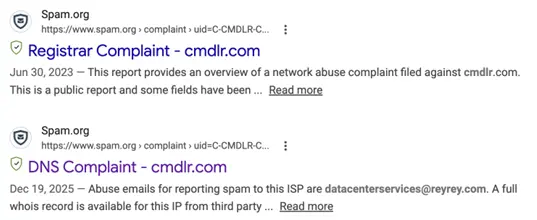
Wearing my privacy skeptic’s hat, I wasn’t sure if the emails were real because the sending address was a little different. Heading off to Google, I did a few different searches. Sharing an example here showing others have had the same concern.
What can we learn from this?
Listen for the skeptic signal. When customers Google your sender address to check if you’re a scam, that’s a trust problem, not a deliverability one.
Use the right data. One stale data point isn’t a campaign. Combine signals, check them against each other, and build a real data quality review so bad assumptions don’t go out the door disguised as personalization.
Execution is the difference between welcome and creepy. Marketing to past customers is fair game. Whether it lands depends on the tone, the timing, the frequency, the channel mix, and whether the premise is actually true.
Coordinate across channels and sellers. Multiple reps, multiple formats, same day: that’s a pile-on, not a campaign. Someone has to own the whole customer, not just their own queue.
Make opting out as easy as opting in. Spammy senders and hard to read unsubscribe links protect your opt-out rate on paper. They break trust in practice.
Measure what actually matters. Opens and replies are vanity metrics when opt-outs, complaints, and future sales are moving the wrong way.
Balance business goals and customer expectations. Put on a privacy hat before every campaign, not after the complaints come in. The goal isn’t less marketing. It’s marketing that the customer doesn’t run from. Literally.
What creepy personalization story do you have? Hit reply, and if you’re just getting to know me – I read every one.
Here’s to marketing we don’t have to run from.
Jodi
💡 When you’re ready, here’s how we can help:
⚙ Privacy Advisory & Implementation: We help companies navigate privacy requirements with confidence. Our advisory support covers strategy, operations, and real-world implementation.
⚙ Fractional Privacy Services: We provide fractional privacy leadership tailored to your needs and pace. From program development to day-to-day support, we help you build and sustain a strong privacy program.