


Last week my father passed away and 24 hours later my beloved dog of 10 years passed away too. Despite my promise of a weekly newsletter, I just couldn’t pull a coherent one together.
Here are my favorite pics of each of them.

This week’s edition might be a little different than others, and I appreciate your willingness to read along.
In the early days of Red Clover Advisors, consultants coined my dog as the Chief Canine Officer. You might have seen or heard him on our calls, heard or seen him on my She Said Privacy/He Said Security podcast, or even in my LinkedIn posts. He brought companionship to each and every workday.
He was my workmate and kept me company under my feet so I couldn’t move my chair, barked to let me know a leaf flew by or to scare away a threat (as a Great Pyrenees, his job was to protect his farm, which was our house!), and asked for ear or belly rubs even while I was on the phone.
I’ve been in Florida with my family all week, and returning home to a quiet house without him is going to be incredibly hard.
I appreciate that I’m several decades into my career, a mom to a teen and tween, and I’m also a daddy’s little girl.
His loss has left a profound emptiness, one that will take time to mend. Nearly every part of my professional and personal fire from my work ethic, creativity, business mind, resilience, and even my love of public speaking was shaped by him.
My dad was in sales or an entrepreneur his whole life. In fact, I came across a certificate from his early years when he was a marketing consultant at a company (or as the certificate says, a “customer marking consulting” – friendly reminder to always spell check!).
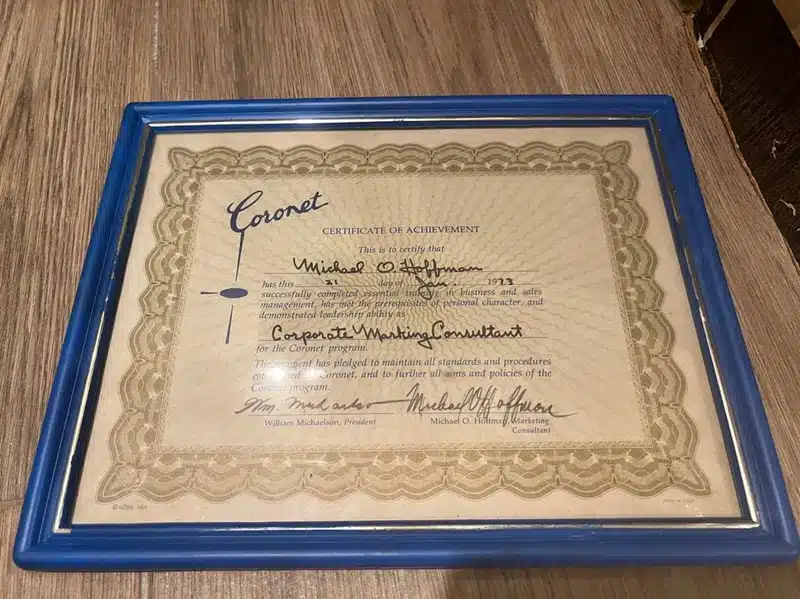
Much of what I have learned in business I attribute to him. As a kid, I spent many Saturday afternoons in his office. He would stop for “just a minute.” Hours later, I was still sitting there.
I’d pretend to type on his computer and answer phones, and then I got “real jobs,” and organized his files with a file folder for EVERYTHING with a label for each one, learned to use a real typewriter, and had countless hours to hear him on the phone conducting business.
See, when I meant everything … even jokes (that he LOVED to tell) had a folder. I found these labels too, which is what I used (even just last year) to make his folders.

Keeping so many folders and papers totally relates to data storage, and that’s an entirely different newsletter for another time.
The ability to learn how to form relationships with people, and how it wasn’t about just “selling” or “pushing” something on someone. Instead, it was about finding an authentic and genuine connection, learning something about the person’s life, and smiling.
It was in these calls that I saw his magic.
I used to say he could sell anything, and he often talked of writing a book. Maybe one day I can pull what I’ve learned together on his behalf. Yes, I found the folder that had some of it even started.
He had a bigger than life personality, was incredibly determined to succeed at everything he did, and problems were just obstacles that needed creative solutions.
I always knew I had his support in anything I did. He always told me and anyone who he could how proud he was of me. I hope I will continue to make him proud.

He had a mantra: Do Your Best (DYB).
It seems so simple. It’s when something seems hard, or you don’t want to do it, that you focus on doing the best you can. While he was a perfectionist, his real focus was getting his kids and really anyone he worked with to find their best potential. Doing average or good enough wasn’t going to have goals met, dreams achieved, or make a difference in the world.
DYB is the reminder to actively push yourself to achieve your very best and be comfortable with the outcome.
I was already on spring break when the news came, so I was out of the office. I told my team I would be heading to Florida for the funeral and then to help my mom likely for the week.
What happened next is a business owner’s dream.
The team was functioning without me. Work continued. Prospect calls taken. Proposals prepared. Client projects kicked off. The tireless work we’ve put into systems and processes made it all work. On the other hand, my to-do list is rather long, and I’m still digging out (so if you emailed me, thank you for your patience).
My dad loved business. While retired, he still loved talking about business. I was always too tired to talk about work when he and I were talking. I just wanted to talk to my dad about anything but work.
Thinking more about it, I wish I had shared more. He was so creative when it came to marketing and sales. My dad was always weaving personal and business, so we’ll shift this newsletter back to privacy.
This entire experience – racing back from spring break to Atlanta, flipping bags, heading back to the airport 10 hours later, and buying a one-way ticket to FL, got me thinking about building sustainable privacy programs.
Leaving this beautiful Colorado sky while literally also taking calls from the Emergency Pet Hospital and his regular vet, I needed something else to think about it. So yes, it’s true … I really did make these connections because clearly the apple didn’t fall far from my dad’s tree!

Being pulled away unexpectedly shows you what keeps moving without you and what freezes in place. Just like my team ran smoothly during a difficult week, privacy programs need that same resilience.
Imagine you have an emergency and need to leave the office suddenly. What would happen to your privacy program?
For organizations with just one privacy contact, what happens when that individual is on vacation or on extended leave? How does that new project with a privacy impact get reviewed? The new vendor that someone wants to bring on board? The privacy rights requests piling up (with a clock that starts ticking).
If there’s no one to ask or it takes too long to get an answer, people will decide to just skip asking altogether and move forward with what they want to do. This puts the company at significant risk.
Many privacy programs do not have consistent or repeatable processes creating bottlenecks or complete misses.
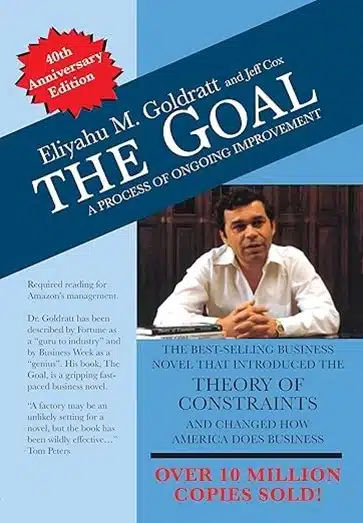
If you want to really study bottlenecks, I’d love to recommend the classic business school book, The Goal, by Eliyahu M Goldratt. It’s truly a must-read.
Bottlenecks happen when most of the privacy know‑how or decision authority sits with one person. If that person is out, momentum slows.
A marketing team might be ready to launch a campaign, but can’t determine whether their tracking approach is acceptable. A product team may be waiting on a privacy review to finalize a feature. I’ve seen vendor contracts sit for two weeks because the only person who reviews data processing terms was unexpectedly out.
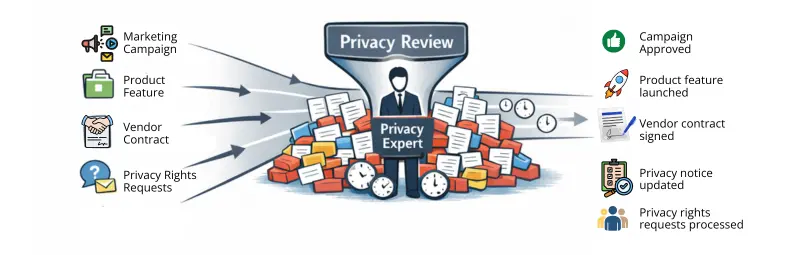
Delays create stress, frustration, and eventually a reluctance to involve privacy at all.
Complete misses are trickier because they often go unnoticed until much later. A team adopts a new collaboration tool because ‘everyone already uses it,’ not realizing it processes personal data; without a clear intake path, no review ever happens.
A privacy rights request gets forwarded to the wrong inbox and quietly disappears while the legal deadline ticks by. A product adds a new data source, but the privacy notice isn’t updated, and suddenly, what’s public no longer reflects reality.
Underneath both patterns is the same issue: a program built around a person instead of a process. When knowledge lives in someone’s head rather than in simple, documented workflows, shared tools, and cross‑trained coverage, everything becomes fragile.
Life doesn’t schedule itself around business needs, and when the unexpected happens, the gaps show immediately.
A stronger approach.
Designing programs so privacy keeps moving even when someone steps away.
This doesn’t require a massive overhaul. A few deliberate steps will make your program sturdier and far less dependent on any single individual:
- Create one simple intake point for anything privacy‑related – new tools, projects, vendors, or data uses. If people aren’t sure where to go, they’ll skip it. Even a short form linked on your intranet or pinned in Slack/Teams keeps work flowing to the right place.
- Cross‑train at least one backup. They don’t need to be a privacy pro – just someone who knows what should happen next, so reviews, requests, and approvals don’t stall when someone’s out.
- Add light automation. Use workflow tools, shared inbox rules, and reminders to move tasks along. Hand‑offs should be system‑nudged, not memory‑based.
- Document the essentials. Create a simple to understand policy, including what needs review, who’s involved, expected timelines, and where decisions live. Make it easy to find.
- Spot‑check for misses. Once a month, scan for ‘shadow’ tools, stale notices, or unopened rights requests. Quick, routine checks catch what the process didn’t.
The goal isn’t perfection – it’s resilience. Build a privacy program that stands on its own two feet so people can step away, care for family, take a vacation, or just handle life, knowing the program and the business keeps moving.
What step can you take so you know privacy keeps moving even when you’re out of the office?
There are so many tips, tricks, and business lessons my dad shared with his teams and colleagues, and over the coming months, I’ll weave them into my content so you can benefit too.
Jodi
💡 When you’re ready, here’s how we can help:
⚙ Privacy Advisory & Implementation: We help companies navigate privacy requirements with confidence. Our advisory support covers strategy, operations, and real-world implementation.
⚙ Fractional Privacy Services: We provide fractional privacy leadership tailored to your needs and pace. From program development to day-to-day support, we help you build and sustain a strong privacy program.