


Turns out a lot of you really resonated with last week’s newsletter. I’m SO grateful for each person who reads each newsletter and says something about how it struck a chord. I’ve loved all the messages, comments, and direct statements, so please do keep them coming. They inspire me to keep talking (which is our theme this week).
People have been sharing how much they like all the personal stories intertwined. This week, I was on Zoom call #101 when I glanced down at my phone and saw my daughter’s school calling.
Yes, I am that mom who has my phone out in front of me for emergency purposes. I never know if the school is calling with an issue or it’s my now middle school daughter using the school phone with a question.
I politely interrupted our discussion on GLBA privacy notices to say, “My daughter’s school is calling; I have to take this.” I did, and the good news was there was no emergency. It was my daughter asking a question about volleyball practice, to which I answered and said I’m on an important call and need to go.
I suppose I could have ignored it, but then all I’d be focused on is what’s going on, and I wouldn’t be present and definitely not super focused to resume our scintillating discussion on GLBA privacy notices.
I’m not alone.
All of us have something else happening outside of work, and sometimes it might be all we’re thinking about.
Your fellow conference call mate, colleague, or employee might also have a phone nearby waiting for a call from a doctor, a school, the babysitter, the assisted living center, a caretaker, a rental application, a mortgage underwriter, a contractor, and the myriad of others who are also a part of real life.
Sometimes the workflow and privacy pow wow need to pause for whatever urgent life event is happening. Then that person can come back to their flow state.
I remember, as a new hire early in my career, hearing sage advice from the president of a company division who was kicking off our day-long training. He said:

If you show up at work and are focused the whole time on how you don’t feel well or someone else has an issue, you’re not going to be productive at your job.
His words never left me. I think about them often, and I really think he was spot on.
Flying home from FL Labor Day weekend, I was channel flipping through Delta’s latest content and came across this interview: The Psychology Of Why People Don’t Like You!
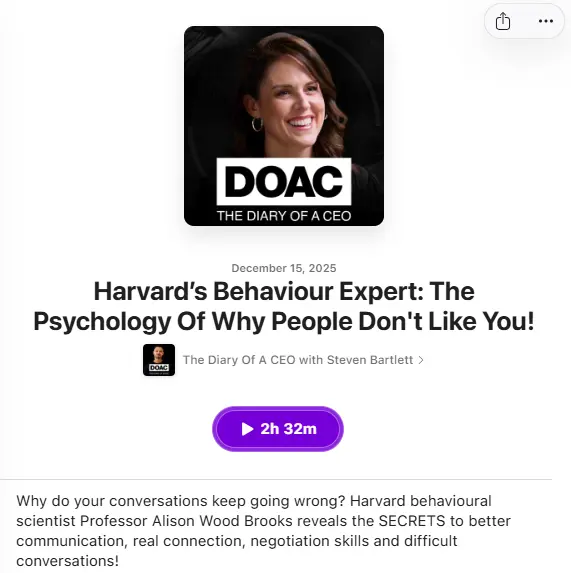
It was an interview with Harvard Business School behavioral scientist Dr. Alison Wood Brooks. If you want to catch up on more podcasts on the Diary of a CEO with Steven Bartlett, check it out here.
I thought, wow, this is really interesting. My older teen daughter peered over and gave QUITE the expression, saying she didn’t think so.
I carried on watching and found that it was quite fascinating to learn about the TALK framework.
We spend all day long communicating and talking to people. Friends, family, co-workers, people we do and don’t like. In each engagement, we’re using words to convey thoughts, ideas, and information on every topic possible.
The basic premise is most people aren’t getting this right. They say the wrong thing, miss saying something, or get anxious about talking. As Dr. Brooks describes her own research focus, she studies why we say things we shouldn’t and don’t say things we should.
Dr. Brooks has spent the past two decades doing extensive research on conversations and created the comprehensive TALK framework.
What is the TALK framework?
Topics – spend 30 seconds thinking of some interesting topics for each person you talk to. This helps elevate beyond the weather and what you did this weekend. Her research found that people who spend even 30 seconds thinking ahead about possible topics have more enjoyable, less anxiety-ridden, smoother conversations (Harvard Business Review IdeaCast, “The Keys to Great Conversation,” March 2025).
Asking– using open-ended questions and thoughtful follow-up questions shows interest from you to the other person. I specifically remember an example shared of how someone might say, “Oh, I went to this new restaurant I love,” and the common response is for the listener to say, “I love it there too and share their own story.” Instead, the suggestion is to ask more questions like “Who did you go with?” or “What did you like about it?”
This one is backed by peer-reviewed research in: “It Doesn’t Hurt to Ask: Question-Asking Increases Liking” (Huang, Yeomans, Brooks, Minson & Gino, Journal of Personality and Social Psychology, 2017), the team studied more than 600 online chat participants plus 110 speed-daters across over 2,000 conversations, and found that people who ask more questions, especially follow-up questions, are better liked and learn more from the person they’re talking to.
Levity – showing warmth or humor to help with those strange, awkward moments. It doesn’t mean telling jokes; it means signaling that you’re a person and this doesn’t have to be adversarial. In privacy work, a lot of conversations start with the other person bracing for a no, and a bit of lightness resets that before the real discussion begins.
Kindness – putting the other person’s needs and feelings first. Respectfully listening and considering other views beyond your own. This is the one I think privacy pros undervalue most. The marketing lead who wants the pixel isn’t trying to purposefully be careless. They are just trying to hit their KPIs.
Starting from that assumption changes the entire tone of the conversation, and it’s usually the difference between being looped in early and finding out after launch.
Find this interesting and want to learn more?
Check out her Harvard Business School profile, and of course Google will help you find her many podcasts and resources.
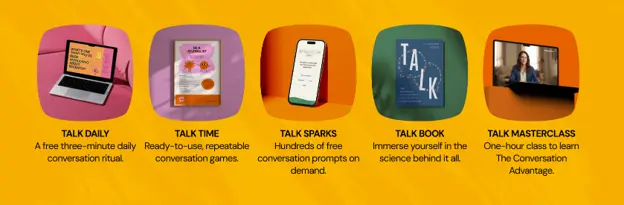
For a daily conversation ritual, repeatable conversation games, a masterclass, and more, check out her website, Talk Studios.
What does this have to do with privacy?
Privacy pros cannot do their job without talking to people, and sometimes we have to convince those same people to do something they don’t really want to do.
Most business stakeholders aren’t raising their hand saying I can’t wait to do a privacy impact assessment. I haven’t seen too many people race to classify cookies and pixels. The lines are fairly short for third-party vendor reviews initiated by the business voluntarily.
Try running TALK through a privacy lens. Here’s an example:
Topics: before the assessment kickoff, spend your 30 seconds on what that team actually cares about – their launch date, their budget, the metric they’re measured on. Focus on them and not on your framework.
Asking: instead of “does this collect personal data?” try “walk me through what happens after someone fills out the form” and then follow up on whatever surprised you.
Levity: a little warmth goes a long way when you’re the person adding three weeks to someone’s timeline or having them answer a lot of very detailed questions.
Kindness: acknowledge out loud that the request is inconvenient, and that you know it, and always offer how to be helpful.
Connection through conversation
I talk (ha, pun intended!) A LOT about building relationships. Being able to have respectful dialogue is going to be essential to creating a strong connection. Having a strong connection is going to be immensely helpful when a risky project comes along needing some privacy attention.
According to Amazon, there are more than 60,000 books on communication. That tells me we have a lot of work to do on communicating, and I hope sharing this framework might help each of us build stronger conversations with each other.
This week, try just the first letter. Take thirty seconds of topic prep before your next stakeholder call and notice whether the conversation goes differently.
Wishing you a great week!
Jodi
💡 When you’re ready, here’s how we can help:
⚙ Privacy Advisory & Implementation: We help companies navigate privacy requirements with confidence. Our advisory support covers strategy, operations, and real-world implementation.
⚙ Fractional Privacy Services: We provide fractional privacy leadership tailored to your needs and pace. From program development to day-to-day support, we help you build and sustain a strong privacy program.