


In our house – summer is here! It’s the end of the school year! The excitement of a new school year is a faint memory. The year was a blur of projects, tests, volleyball games, dance and chorus recitals, talent shows, college nights, and so much more.
By the end of the school year, we’re now all exhausted and ready for a break. We’re physically and mentally tired.
It got me thinking that May is Mental Health Awareness Month. The statistics are sobering, and they hit even harder after recently learning that two teens just one degree away from my circle died by suicide this week. I wanted to do my part in raising awareness.
A few numbers that really stood out to me, according to the National Alliance on Mental Illness: 1 in 5 U.S. adults experience mental illness each year, and 1 in 6 U.S. youth ages 6-17 experience a mental health disorder each year. 50% of all lifetime mental illness begins by age 14, and 75% by age 24. And suicide is the 2nd leading cause of death among people ages 10-14 in the U.S. As a parent, this frightens me significantly.
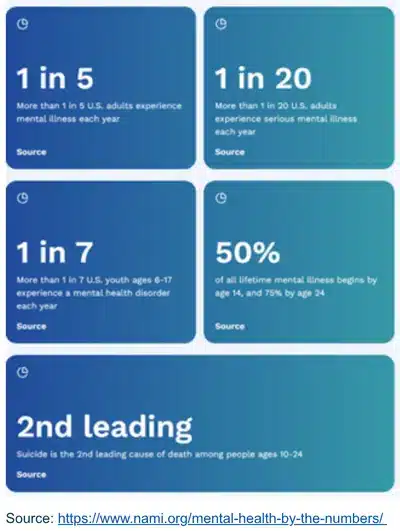
These are not just “other people.” Someone in your circle, friends, family, neighbors, or colleagues, is likely impacted.
Mental health impacts our physical health too.
Every 34 seconds, someone in the United States dies from heart disease. As nearly half of the country suffers from some form of cardiovascular disease (CVD), another 1 in 4 adults experience a mental health disorder in their lifetime, signaling an inevitable overlap.
A recent report from Emory University shows certain mental health conditions escalate the risk of developing heart disease by 50-100% and adverse outcomes from existing heart conditions by 60-170%.
Translation: taking care of your mental health is taking care of your heart.
Bringing this closer to the privacy community, I’m noticing that privacy professionals are TIRED, and I’m worried these professionals might follow the footsteps of CISOs who are experiencing record burnout.
According to a Proofpoint survey, 63% of CISOs say they have experienced or witnessed burnout within the past year. The same survey found that 66% of CISOs feel their organization is unprepared to handle a cyberattack, and 68% feel at risk of a material cyberattack in the next 12 months – the kind of pressure that does not exactly send you home at 5 pm.
On the privacy side, we are juggling a patchwork of state privacy laws (with new ones added almost every legislative session), GDPR, AI laws like the ever-changing EU AI Act or repealed and then replaced Colorado AI Act, sector-specific rules, and a constant stream of new work ranging from data inventories, privacy risk assessments, vendor reviews, and more.
Privacy is Hard Work Today
I talked to a privacy attorney recently, and we shared that being a privacy professional today is hard work. The barrage of new laws and requirements is creating an incredibly complex patchwork that is exhausting to stay on top of and to constantly keep evaluating and explaining to clients.
I feel like I’m playing whack-a-mole keeping up with it all. She was tired, and we talked about the need to ensure health comes first. If no one is healthy, there is no one to explain all these privacy laws to.
As someone who basically uses every minute of every day to either work, parent, or (try to) exercise, I’ve learned to really embrace breaks.
Even little ones are good. I’m constantly getting water, stretching, or even doing balancing exercises while on the phone. When I can squeeze it in, even a 15-minute yoga practice is a great way to start the day (thank you Anna Greenberg of Peloton, who reminded me this morning that my 15-minute class was a gift to myself and not to feel bad if it’s just 15 minutes!)

Breaks are helpful to reset and good for us as noted in this Emory University Rollins School of Public Health article. The research backs this up: a frequently-cited DeskTime study of high performers found that the most productive people work for about 52 minutes and then break for 17 minutes.
A University of Illinois study found that even brief diversions from a task can dramatically improve focus on that task over long periods. And microbreaks of just 10 minutes or less have been linked in a meta-analysis published in PLOS ONE to measurable improvements in energy and reductions in fatigue.
The pattern is consistent – the brain is not built to grind for eight straight hours, and pretending otherwise costs you the quality of the work you were grinding on in the first place.
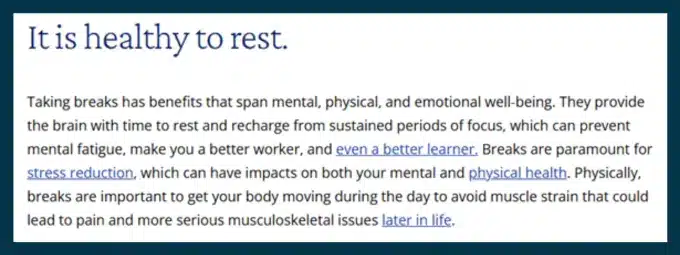
What I find is that on a break, whether it be as simple as a walk outside, a night away from working, or a full vacation, my brain is full of ideas or solutions to problems. That seems counterintuitive to many people.
Not having to balance meetings, slacks, proposals, payroll, and the myriad of other things, or sitting at a blank screen trying to figure out what to write in these weekly newsletters, allows my brain the rest it needs to rejuvenate.
I’ve also been known to have a lot of silent car rides. No one is in the car, and then no podcast, no music, no phone calls. Just the chance to think, look at the squirrel crossing the street, the bird in a tree, the new storefront that just came in, and my mind then naturally wanders to whatever issue I’m trying to solve, how to phrase something differently, or a brand new idea. It’s really quite lovely, and I encourage you to try it.
That’s why I’m encouraging you to ensure breaks are scheduled throughout your day, your week, and your summer. The daily and weekly ones will keep your mind fresh, and there’s a good chance you’re going to have a better way to solve a problem, a story to share to help a stakeholder better understand something, and it will keep your brain sharp.
The Cleveland Clinic thinks so too:

The real vacation and step away from the office will help your entire body reset. And yet Americans are famously bad at actually taking the time – a Pew Research study found that 46% of U.S. workers who get paid time off take less than they are offered, with the top reasons being fear of falling behind and worry that no one else can cover the work.
Sound familiar? If you’re like me, going on vacation has the ramp up of getting everything done, and that often feels like cramming, and on the return, there is a pile of to-do’s. Even still, the time away is worth it, and the memories with family, friends, or just your own adventure is what life is all about.
Short weekend trips count too, and when filled with activities that fulfill you, can be just what the body and mind needed.
One of the questions we always ask our She Said Privacy/He Said Security podcast guests is what do you like to do for fun. We have A LOT of people say travel, and they have shared some exotic locations before.
Help your privacy professional community out – where is a favorite place you’ve been and would recommend?
As we close out Mental Health Awareness Month and head into summer, here is what I want to leave you with. The work we do in privacy and security matters – but it only matters if the people doing it are still standing.
Protecting data is a marathon, not a sprint, and the regulatory landscape is not slowing down. The patchwork will still be there on Monday. The new state law will still be there when you get back from the lake. Your inbox is always there (and my goal has never been inbox zero).
What is not guaranteed is your health, your family time, and the version of you that shows up to do this work for the long haul. So take the walk. Take the silent car ride. Take the vacation. Schedule the break before the burnout schedules it for you.
Help is Available
If you or someone you know is experiencing mental health challenges, PLEASE get you or them help. There are so many resources available for free through employer assistance programs, non-profits, and multiple free hotlines like the 988 Suicide and Crisis Lifeline or the free NAMI helpline to get started.

Our important work can have the greatest impact on the world when the privacy community is healthy.
Jodi
💡 When you’re ready, here’s how we can help:
⚙ Privacy Advisory & Implementation: We help companies navigate privacy requirements with confidence. Our advisory support covers strategy, operations, and real-world implementation.
⚙ Fractional Privacy Services: We provide fractional privacy leadership tailored to your needs and pace. From program development to day-to-day support, we help you build and sustain a strong privacy program.