


For years, the dominant pitch in privacy has been fear. Lead with the fines. Show them the enforcement actions. Make sure they understand what happens when things go wrong.
The marketers I have worked with over the years pushed me in exactly that direction. It never felt right to me. Fear is a motivator, but it has never been the story I wanted to tell, and honestly, it is not the most interesting story to tell.
I wish I had screenshots going back to my earliest work in this field, because I have been talking about trust well before it became the buzzword everyone plasters on their website and sticks in their keynote deck.
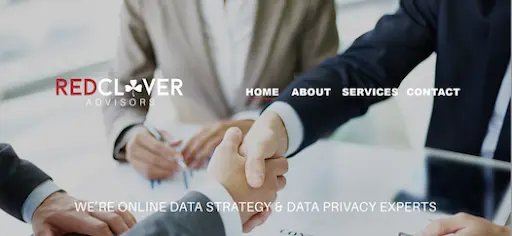
But since it’s fun to show old screenshots, here’s an early day screenshot of the first Red Clover homepage (I think to myself now AHHH!!!)
Privacy doesn’t have to be a cost center or a compliance checkbox. It can drive real savings and real revenue. I’ve held this view for a long time, even as the people around me pushed the opposite message.
The more interesting story is about what privacy actually does for a business when you treat it as a strategic asset rather than a legal obligation. I have seen companies use privacy principles to cut costs, accelerate sales cycles, and build the kind of customer trust that is genuinely hard to manufacture.
None of that came from fear of fines. It came from deciding that privacy was worth doing well, and then figuring out what that looked like in practice.
I came up in this field thinking about trust. How do you build it? How do you demonstrate it to customers? Privacy done well is one of the clearest signals a company can send that it takes its responsibilities seriously. And that signal has business value. It shows up in deals closed, in customer retention, in the due diligence process, and in the cost structure of running the business.
A recent conversation brought all of this into sharp focus, and it felt worth sharing. (Anonymized, of course.)
The CRM Problem Nobody Talks About
This marketing team didn’t want to import all the data their business stakeholders were pushing them to load into their CRM. Stakeholders wanted contacts in the system, and they wanted volume. The marketing team was hesitant, and they had a good reason.
Many CRMs and email marketing tools charge by record volume. The more contacts a company stores, the higher the monthly bill. This company had no purge process in place, so records just accumulated.
People left companies, changed roles, moved on, and those contacts stayed right where they were, quietly driving up costs month after month. (We update our own records constantly when someone moves on. This company was not doing that.)
But the cost of storing unnecessary data goes beyond the licensing bill. This is something people miss. Every system where data lives, whether that is a CRM, a marketing platform, a data warehouse, or a file share, carries security risk. More data means a larger attack surface.
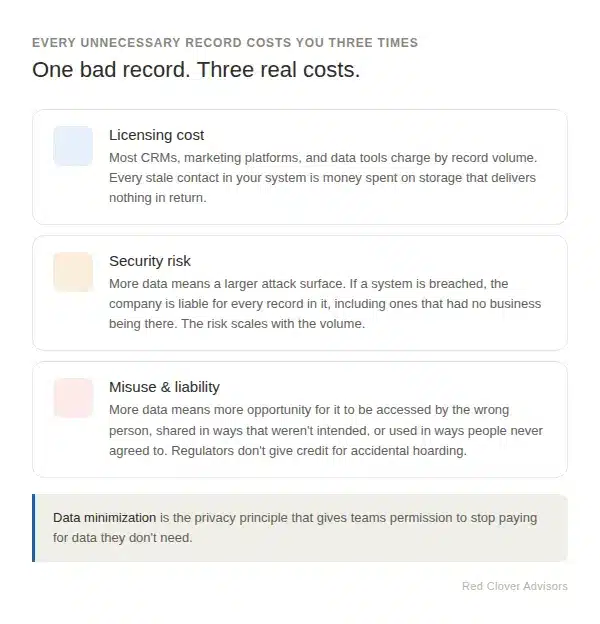
If that system is breached, the company is now liable for every record that was in it, including the ones that had no business being there in the first place. Regulators and plaintiffs do not give credit for accidental hoarding.
And beyond the breach scenario, more data means more opportunity for it to be misused, accessed by the wrong person internally, shared in ways that weren’t intended, or used in ways that the people whose data it is never agreed to. The risk scales with the volume.
So we got into a conversation about data minimization. Most privacy laws are built around a straightforward principle: collect, use, and store only the data you actually need. That sounds like a restriction. For a marketing or sales team, it is actually a business advantage.
Marketing and sales do need data. But they need quality data, not just volume. A list of 5,000 engaged, accurate contacts will outperform a bloated database of 50,000 that includes people who left their companies two years ago and email addresses that bounce.
That smaller, cleaner list costs less to maintain, carries less risk, and the savings can go toward campaigns that actually move the needle.
Think about what a company is actually buying when it pays to store records that will never convert. It is not a pipeline. It is not relationships. Data minimization is the privacy principle that gives teams permission to stop doing that, and in a lot of companies, someone has been waiting for exactly that permission.
The marketing team got genuinely excited about this framing. Privacy gave them a legitimate argument for pushing back on data practices that were costing money and creating risks that weren’t worthwhile. That is a conversation worth having in almost every organization.
One habit they wanted to address was scraping LinkedIn. This one comes up constantly. Someone pulls contacts from LinkedIn, drops them into a spreadsheet, and uploads the whole thing into the CRM. It feels efficient. But under many privacy laws, data scraped from professional networks is not considered public in the way people assume.
Please just follow me on LinkedIn – don’t scrape my data and don’t send me 1400 emails or calendar invites.
Just because a profile is visible doesn’t mean that data is free to harvest for commercial purposes. Scraping and importing without a lawful basis is a legal liability, and the data quality tends to be poor on top of it. Those contacts didn’t raise their hand. You are paying to store data that creates risk and delivers nothing.
The same logic applies to bulk Outlook contact lists. Someone uploads years of accumulated contacts from old email threads and networking events. Now the CRM has thousands of records with no clear legal basis and no signal that those people ever wanted to hear from this company.
Data minimization (which is required by most privacy laws these days) gives teams a practical reason to say no, and that conversation is a lot easier when privacy is framed as protecting and helping the business rather than restricting it.
Privacy and good data hygiene are really the same thing. Keeping your database clean and current is what makes marketing work better, reduces security exposure, and keeps licensing costs from quietly climbing while nobody is paying attention.
The Sales Process Nobody Optimizes
Here is the second way privacy becomes a revenue driver, and it comes up constantly in B2B sales.
If you sell to other businesses, especially in regulated industries or to larger enterprises, you have probably seen this pattern. The sales conversation goes well, there is real interest, and then it stalls.
The prospect’s legal or security team gets involved and the questions start. How do you handle personal data? What are your retention policies? How is data used in AI training? What certifications do you hold? Who are your sub-processors?
These are reasonable questions. Any company buying a product or service that touches their data should be asking them. But answering them can drag on for weeks.
Emails go back and forth, internal meetings get scheduled to track down answers, and the deal sits still while the prospect juggles several other vendors. Meanwhile, another vendor might have the information more readily available, and they close the sale faster.
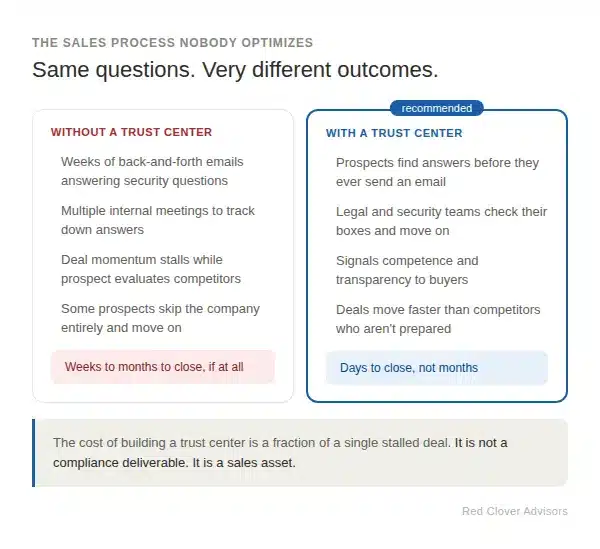
Companies that have built trust centers sidestep most of this. A trust center is a dedicated place on a company website where prospects can find clear answers to the most common due diligence questions without having to ask.
Security certifications, data handling practices, AI usage policies, and sub-processor lists. Done well, it answers the first round of questions before anyone sends an email, and the prospect’s team can review it and move forward without a two-month back and forth.
I’ve seen firsthand that companies that have sales-ready one-pagers addressing privacy & AI concerns have shorter sales cycles. When a prospect asks how you handle data, and a rep can immediately send a clear, organized document, that signals competence and transparency.
Companies with good documentation move through vendor diligence much faster, while the ones without it drag through the process and risk losing the deal entirely to a competitor who did the prep work.
This is where privacy pays for itself directly. The cost of building a trust center is a fraction of a single stalled deal, and the benefit compounds. Every prospect who gets fast, clear answers is one fewer deal stuck in legal review.
While some companies will build a trust center from scratch, it doesn’t have to be that way. Companies using Vanta, Drata, SafeBase, and many others have a trust center framework built in and you just need to put up the link. We’re a Vanta partner – if you’re interested in learning more, let us know.
Time is money in sales. Privacy documentation is one of the most underused tools a sales team has. It is not a compliance deliverable. It is a sales asset.
The Bigger Picture
Privacy done well is not about avoiding fines. That is a baseline, not a strategy.
The companies getting real value from their privacy programs have figured out how to make it work for the business. Clean data costs less, carries less risk, and performs better.
Sales sheets and/or a trust center removes friction from deals that should be closing. A culture that takes data minimization seriously protects the company from the kind of sprawling, unmanaged data footprint that creates both cost and liability.
Privacy is an investment worth making and is far more than a cost center.
Jodi
💡 When you’re ready, here’s how we can help:
⚙ Privacy Advisory & Implementation: We help companies navigate privacy requirements with confidence. Our advisory support covers strategy, operations, and real-world implementation.
⚙ Fractional Privacy Services: We provide fractional privacy leadership tailored to your needs and pace. From program development to day-to-day support, we help you build and sustain a strong privacy program.